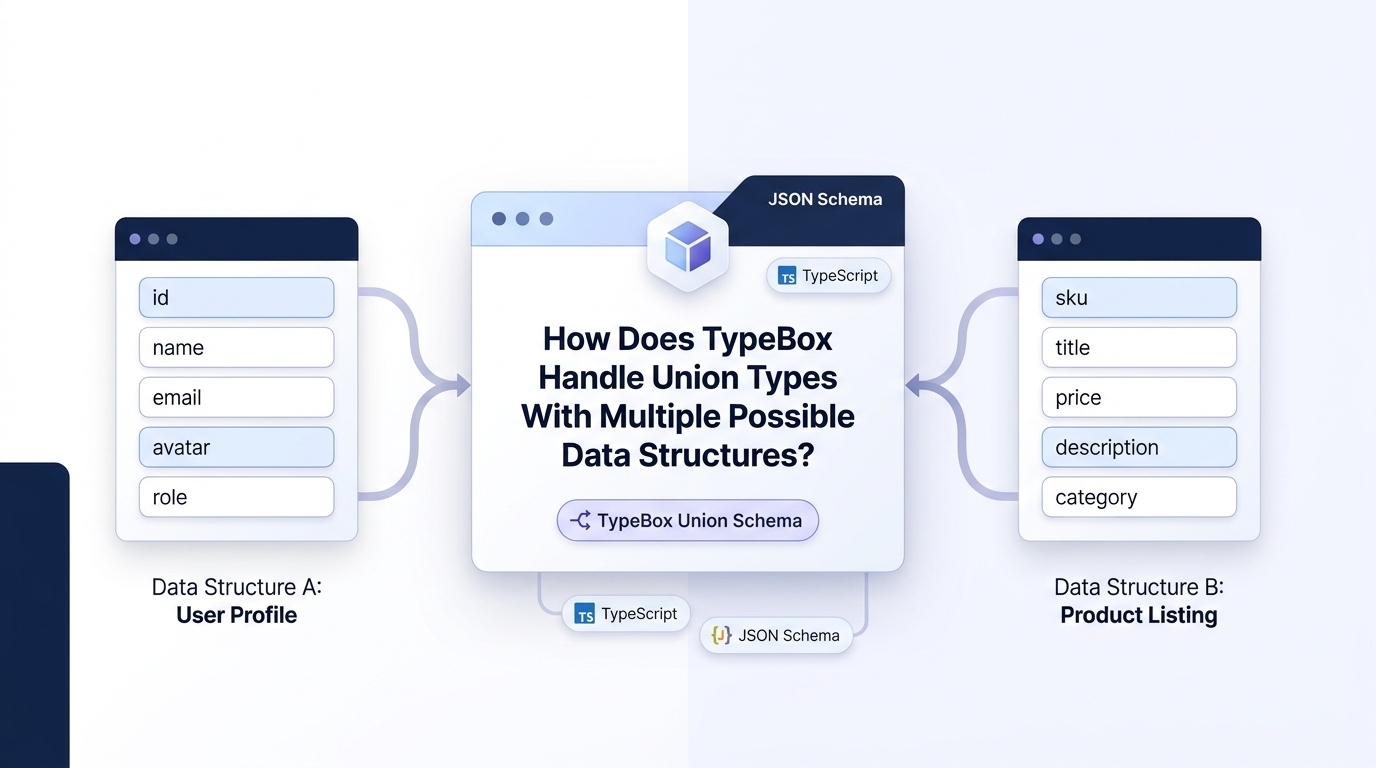
TypeBox handles multiple possible data structures through union types, allowing developers to define several acceptable formats within a single schema. Instead of creating separate validation systems for different object structures, developers can combine multiple schemas and let TypeBox determine whether incoming data matches at least one accepted alternative.
TypeBox union types are particularly useful when applications handle different API responses, user roles, payment methods, or data formats. They provide flexibility while maintaining JSON Schema validation and TypeScript type safety, making it easier to manage complex data structures in modern applications.
Read More: Can TypeBox schemas be shared between frontend and backend applications?
How TypeBox Handles Union Types
TypeBox supports union types through its Type.Union functionality, which combines multiple individual schemas into one definition. Each schema represents a possible data structure, and incoming data is considered valid when it satisfies at least one of the alternatives.
This approach follows the same principle as TypeScript union types, where a value can belong to more than one possible type. TypeBox extends this functionality by providing runtime validation through JSON Schema, allowing applications to check actual data rather than relying only on development-time type information.
Understanding Multiple Possible Data Structures
Multiple possible data structures occur when an application accepts different formats for similar information. For example, an account management system may support customer profiles and business profiles, with each containing different properties and validation requirements.
TypeBox allows developers to represent these alternatives without combining every possible property into one complicated object. Each structure maintains its own requirements, making the overall schema easier to understand, validate, and maintain.
How TypeBox Validates Alternative Schemas
TypeBox validates alternative schemas by checking whether incoming data matches at least one of the definitions included in a union. This behavior generally uses JSON Schema’s anyOf keyword, which allows multiple possible structures to be accepted through one validation definition.
For example, a payment application might accept card payment information or bank transfer information. Each payment method has different required properties, but both can belong to the same union schema. If incoming data matches neither alternative, validation fails.
Using Literal Values to Distinguish Object Structures
Literal values help TypeBox distinguish between different object structures by requiring specific properties to contain predefined values. This is useful when multiple alternatives share common fields but need different identifiers to make their structures recognizable.
For example, an application may support administrator and customer accounts. Both account types might contain a name and email address, but their role properties can contain different fixed values, helping developers identify which structure the incoming data represents.
Understanding Discriminated Unions
Discriminated unions use a shared identifying property to distinguish between different alternatives within a union schema. In TypeBox, developers can create this structure using object schemas and literal values, giving each alternative its own unique identifier.
This approach makes complex data structures easier to manage because applications can determine which alternative they are handling. Discriminated unions are particularly useful for API requests, payment systems, event processing, and applications that support multiple operation types.
Handling Different Data Types Within a Union
TypeBox unions can combine different basic data types, including strings, numbers, booleans, and null values. This allows developers to define flexible fields that accept more than one valid type without removing their validation requirements.
For example, an application setting might accept either a text value or a number depending on the configuration. Similarly, an optional data field may accept a string or null when information has not been provided. Union validation ensures that the supplied value matches an accepted type.
Common Use Cases for TypeBox Union Types
TypeBox union types are useful in applications where the same system needs to process multiple valid data formats. They allow developers to maintain separate structural requirements while providing one organized validation approach for different operations.
Common use cases include:
- API requests: Accept different request formats for multiple operations.
- User accounts: Support customer, administrator, and business profiles.
- Payment processing: Handle different payment methods and their required information.
- Event systems: Validate multiple event structures.
- Configuration settings: Support different value types.
- API responses: Represent successful and error response formats.
Important Considerations When Using Union Schemas
Union schemas should be designed carefully to avoid overlapping structures and unnecessary complexity. When multiple alternatives share similar properties, an incoming value may match more than one schema, making it difficult for application logic to identify the intended structure.
Using literal discriminator properties can help make alternatives more distinguishable. Developers should also define required properties carefully, manage unexpected additional fields, and organize complex schemas into reusable definitions to maintain predictable validation behavior.
Conclusion
TypeBox union types allow developers to validate multiple possible data structures through one flexible schema while maintaining TypeScript type safety. By combining alternative object definitions, different data types, and literal discriminator properties, applications can handle complex data formats more consistently. This makes unions particularly useful for API payloads, payment systems, user roles, and event-driven applications that require reliable runtime validation.
Leave a Reply