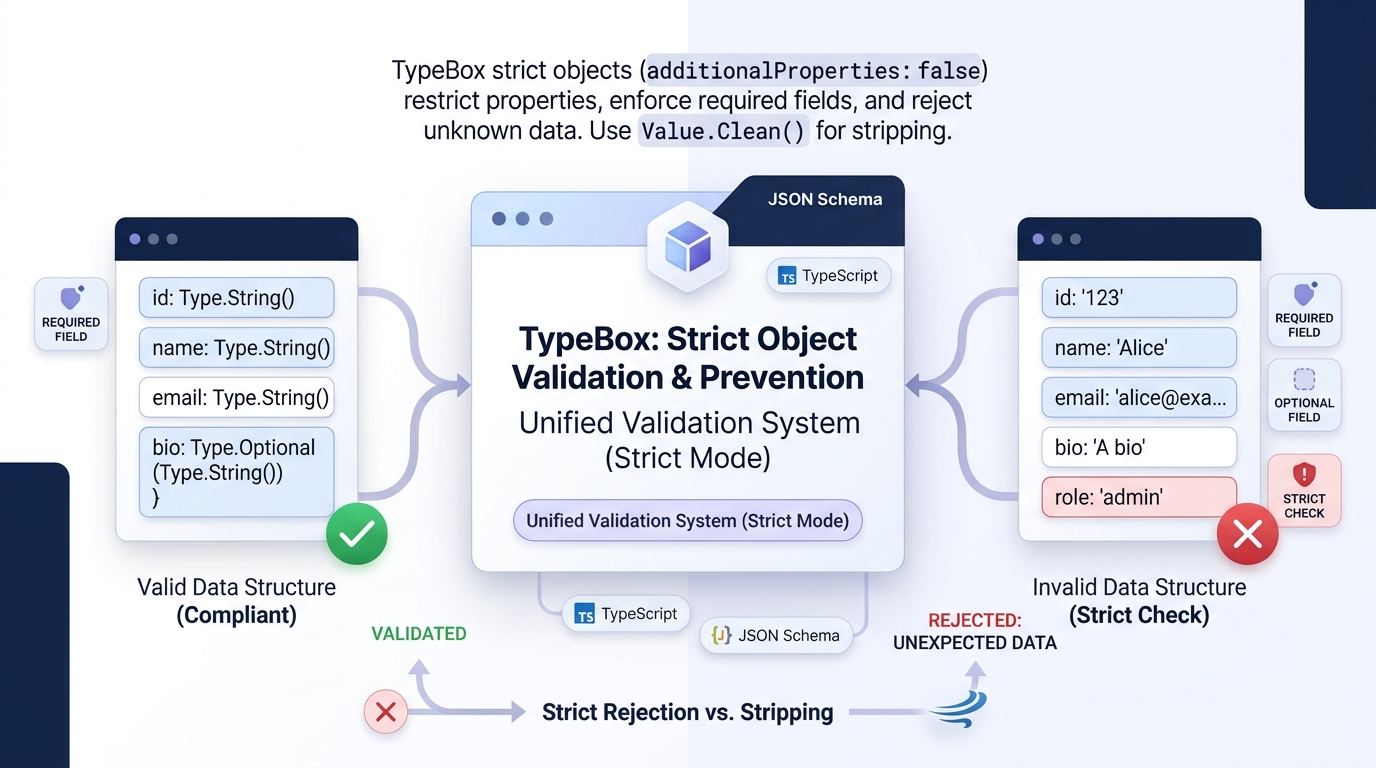
By default, nothing dramatic: the data still passes. TypeBox additional properties are the fields that arrive in an object even though the schema never mentioned them, and unless you deliberately restrict them, validation accepts the object and the extra fields simply ride along untouched. They are not checked, not converted and not removed.
Only when a schema is configured to forbid additional properties does their presence turn into a validation failure. That default surprises many developers the first time they meet it, because a schema feels like it should be a complete description of what an object may contain. In JSON Schema, however, an object schema describes the fields it cares about and stays silent about the rest, and TypeBox follows that convention.
Whether silence is the right choice for your project is a design decision. This article explains what counts as an additional property, what happens in each configuration, and how to choose strictness deliberately.
What Counts as an Additional Property in an Object Schema
An additional property is any key in the data that the object schema does not declare. If a schema describes a user as having a name and an email, then an incoming object carrying a nickname, a legacy identifier or a debugging flag has three declared-or-undeclared parts: the two known fields, and everything else, which falls into the additional category.
The category is about names, not values. An undeclared field counts as additional no matter what it holds, whether that is a harmless string or an entire nested object.
Keeping Two Failure Kinds Separate
Conversely, a declared field with a bad value is not an additional property problem at all; it is an ordinary validation failure on a known field. Keeping those two failure kinds separate makes error reports much easier to reason about.
Why Extra Fields Appear in Real Systems
Additional properties appear for mundane reasons. Producers add fields before consumers update their schemas. Older clients keep sending retired fields long after a redesign.
Intermediaries attach metadata of their own. None of this implies malice or even carelessness; it is the normal friction of systems that evolve at different speeds, and it is why TypeBox, like JSON Schema generally, treats tolerance as the sensible starting point.
Additional Is Not the Same as Missing
It is also worth separating additional properties from missing ones. A schema can be relaxed about extras while remaining firm about required fields, and the two settings pull in opposite directions: one governs what may arrive uninvited, the other governs what must always show up.
The Default Behaviour When Extra Fields Appear in Data
Under the default configuration, validation looks the other way. The validator checks every declared field against its rules and ignores the rest of the object entirely. An object with the right name and email plus four undeclared fields validates exactly as cleanly as the same object with nothing extra.
The extra fields are also left physically untouched. They remain in the object after validation, available to any later code that happens to look for them, and they will be serialised along with everything else if the object is sent onward. This pass-through quality is why tolerant schemas are popular at system boundaries that aggregate data from several sources: nothing is silently destroyed on the way through.
What Tolerance Means for Stored Data
There is a subtle consequence for teams that store validated data. Whatever extra fields arrived are what gets stored, including fields nobody on the team recognises.
Over time, stored objects accumulate historical extras like sediment. That is rarely an emergency, but it explains the mysterious legacy keys that surface whenever someone finally inspects the database with fresh eyes.
Why the Default Optimises for Interoperability
The default, in short, optimises for interoperability. Producers and consumers can evolve independently, minor version differences stop being breaking changes, and the schema enforces the contract it actually cares about rather than policing everything that travels with the data.
How Validation Results Change When Additional Properties Are Restricted
Restricting additional properties flips the validator’s posture from tolerance to gatekeeping. With the restriction switched on for an object schema, the presence of any undeclared key fails validation, even when every declared field is perfectly valid. The error identifies the offending property, so the sender can see exactly which field the schema refused to accept.
This is a stronger contract, and it changes the failure profile of a system. Requests that previously sailed through now fail because a client sent a field the schema does not know. During development that strictness is valuable: typos in field names, which tolerant validation would let slip through as silent extras while the intended field stayed missing, are caught immediately and noisily.
Selective Strictness and the Removal Alternative
Strictness can also be applied selectively. A schema language that treats each object independently lets you forbid extras on sensitive objects while leaving aggregating or forwarding objects tolerant. Nested objects make their own choices too, so a strict outer record can contain a deliberately open inner one, such as a metadata bag whose whole purpose is to carry arbitrary extras.
A related middle path is removal rather than rejection. Some teams prefer tooling that strips undeclared fields during or after validation, keeping the data that matters and discarding the rest. That approach suits stored data and forwarded messages, though it should be a deliberate pipeline step rather than a surprise, because silently discarding fields that another system expected can move the bug rather than fix it.
How Extra Fields Affect the TypeScript Side of the Schema
On the static side, the generated type describes the declared fields and says nothing about extras, which creates an asymmetry worth understanding. At runtime an object may carry additional properties; in the type system, those properties are invisible. Code reading validated data through its type sees exactly the declared shape and nothing more.
TypeScript’s own behaviour adds a wrinkle. The language performs excess property checks on fresh object literals, so hand-written data assigned directly in code can be flagged for extra fields even while identical data arriving from outside passes validation without comment. Developers occasionally find this backwards, strict where they write data and relaxed where they receive it, but each behaviour guards a different moment: literals are checked at authoring time, external data at the boundary.
The Practical Consequence for Trusting Your Data
The practical consequence is about trust. Code that needs a field should not assume it can fish undeclared extras out of validated data in a type-safe way, because the type does not know they exist.
If a field matters, declare it in the schema, possibly as optional. That is also the correct response when a supposedly extra field turns out to be load-bearing in production: promote it into the contract, where both the validator and the types can see it. Questions about declared-but-absent fields belong to the neighbouring topic of what happens when an optional property is missing, which pairs naturally with the strictness decision.
Deciding Strictness for APIs That Receive Outside Data
For public APIs and webhooks, tolerance is usually the safer default. Senders include partner systems, older mobile apps and third-party tools you do not control. Rejecting their requests over an extra field they consider harmless creates integration failures that are hard to debug from the other side, and the sender often cannot change quickly even when they want to.
Strictness earns its keep in narrower settings. Internal messages between services owned by one team benefit from loud failures, because both sides can be fixed in the same afternoon. Security-sensitive payloads are another candidate: when an object drives permissions, pricing or identity, accepting undeclared fields creates room for confusion about which fields actually influenced a decision, and a strict schema removes that ambiguity.
A Layered Policy Many Teams Adopt
A workable policy many teams adopt is layered. The public boundary stays tolerant so integrations do not shatter, while the objects that drive internal decisions are strict. Whichever you choose, document it per schema rather than by habit, because the next developer will otherwise assume the opposite of what you intended.
When to Revisit the Choice
Revisit the choice when the data changes owners. A schema written for an internal tool that later becomes a partner-facing contract should usually loosen; a tolerant prototype that hardens into a payment flow should usually tighten.
Strictness is not a personality trait of the codebase. It is a per-boundary decision about who sends the data and what a surprise field could cost.
Frequently Asked Questions
Does TypeBox reject extra fields by default?
No. Following JSON Schema convention, extra fields are allowed by default and pass through validation untouched. Rejection happens only when the object schema is configured to restrict additional properties.
Are additional properties removed during validation?
Not by the validator itself. Extra fields stay in the object after a successful check. Removing them is a separate, deliberate step some teams add to their pipeline.
Can I forbid extra fields on one object but allow them on another?
Yes. The setting belongs to each object schema individually, including nested objects, so strict and tolerant shapes can be mixed within a single larger schema.
Do extra fields appear in the generated TypeScript type?
No. The generated type contains only the declared fields. Extras may exist at runtime, but code cannot access them in a type-safe way unless they are declared in the schema.
Conclusion
When a TypeBox schema contains additional properties in the data it receives, the default outcome is calm acceptance: declared fields are checked, extras are ignored and left in place. Restricting them turns the same situation into a clear validation failure, which protects sensitive contracts and catches naming mistakes early.
The generated types only ever describe declared fields, so anything that matters should be written into the schema. Choose tolerance at open boundaries and strictness where surprises are expensive, and the behaviour stops being a surprise itself.