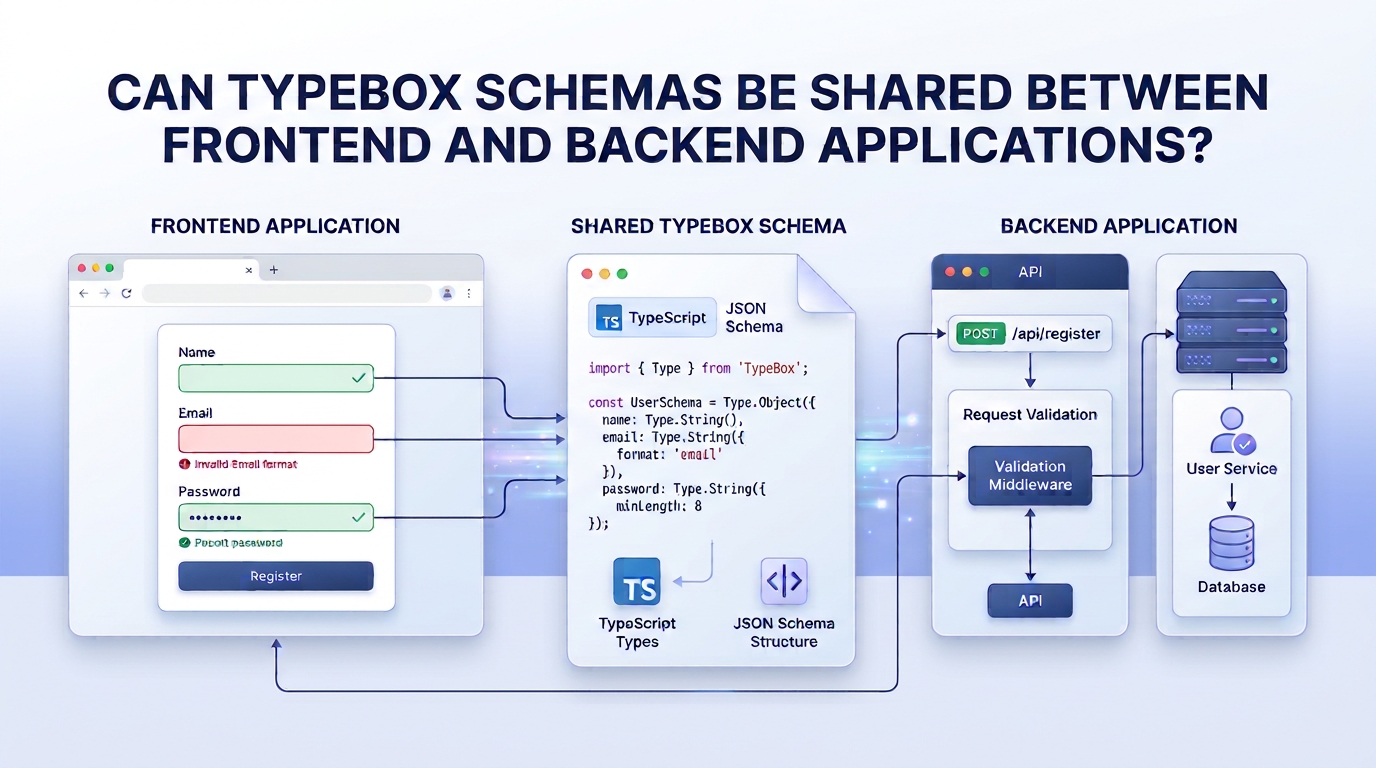
Yes, TypeBox schemas can be shared between frontend and backend applications, allowing developers to maintain one consistent definition of their data structures and validation rules. Instead of creating separate schemas for each application, developers can organize reusable TypeBox definitions in a common package and import them wherever needed. This approach is particularly useful for full-stack TypeScript projects where frontend forms, API requests, and backend services need to work with the same data.
TypeBox shared schemas help reduce duplicated validation logic, improve type consistency, and simplify application maintenance. Both environments can use the same schema definitions for their respective validation requirements, while the backend continues to perform independent checks before accepting incoming data.
How TypeBox Makes Schema Sharing Possible
TypeBox makes schema sharing possible through its ability to create JSON Schema definitions that also provide corresponding TypeScript types. Developers can define a data structure once and reuse that definition across different parts of an application without manually maintaining separate interfaces and validation rules.
This is important because frontend and backend applications often work with identical information but handle it differently. For example, a registration form collects user information on the frontend, while the backend receives and processes that information through an API. Using a common schema helps both applications understand the expected data structure.
Another advantage is that TypeBox connects static type checking with runtime validation. TypeScript helps developers identify type-related mistakes during development, while TypeBox schemas can be used to validate actual JavaScript values when data enters an application. This makes schema definitions useful beyond simple type declarations.
Maintaining One Consistent Data Definition
A shared schema provides a central definition that multiple applications can reference. When a project uses the same user, product, or account structure across different environments, developers do not need to recreate the same properties and validation requirements separately.
For example, an application might require every user record to contain a username, email address, and account status. The frontend can use the shared definition when preparing form data, while the backend can use it when checking incoming requests.
If the required structure changes, developers can update the central schema and distribute the change to the applications that depend on it. This reduces the possibility of outdated definitions creating unexpected differences between environments.
How Shared TypeBox Schemas Work Across Applications
Shared TypeBox schemas work by making a common schema definition available to multiple applications through a shared directory, workspace, or reusable package. Each application imports the required definitions and uses them according to its responsibilities.
For example, a React frontend and a Node.js backend can both depend on the same schema package. The frontend uses the definitions to understand expected form data, while the backend uses them to validate incoming API information. Neither application needs to maintain an independent copy of the original schema.
The important distinction is that sharing a schema does not mean sharing application logic. The frontend and backend remain separate environments, but they follow the same agreed data structure.
Understanding the Shared Validation Workflow
The workflow begins when developers define the required data structure in a common location. That definition becomes available to the frontend and backend through their package dependencies.
When a user enters information into a frontend form, the application can check whether the submitted values match the shared schema. If the data passes validation, the frontend can send it to the backend through an API request.
The backend then checks the received information independently before continuing with its processing. This second validation step ensures that the server does not rely on the browser’s validation results.
Both applications therefore use a consistent schema, but each performs validation at its own data boundary. This is one of the main reasons shared schemas are useful in full-stack development.
Organizing Schemas in a Shared TypeScript Package
A dedicated shared TypeScript package is one of the most practical ways to organize TypeBox schemas when multiple applications need access to the same definitions. It provides a central place for reusable data structures and makes them easier to maintain as a project grows.
For example, a full-stack project might contain separate frontend and backend applications alongside a shared package responsible for common schemas. User definitions, product structures, account information, and API-related data contracts can be organized within that package.
This arrangement is especially useful in monorepos because multiple applications can access shared resources without maintaining duplicate files. Developers can also separate different schema categories to keep the package organized.
Keeping Shared Definitions Organized
A well-organized schema package should group definitions according to their purpose. User-related schemas can remain together, while product, authentication, and order-related definitions can have their own logical sections.
This makes it easier for developers to locate the correct schema and understand which applications depend on it. It also prevents a single shared file from becoming difficult to manage as the number of definitions increases.
The package should focus on reusable data structures rather than application-specific functionality. Database operations, frontend components, server configuration, and business services should remain in their respective applications.
Using Shared Schemas for Frontend Validation
Frontend applications can use shared TypeBox schemas to check form data before submitting it to a backend API. This helps identify missing information, incorrect value types, and other validation problems while users are interacting with the application.
For example, an account registration form may require a valid email address, a username with a minimum length, and other necessary information. By using the shared definition, the frontend can follow the same structural requirements expected by the backend.
This approach also makes frontend validation easier to maintain. When a shared data requirement changes, developers can update the central definition rather than manually adjusting multiple independent validation structures.
Improving Form Validation and User Experience
Shared schemas can help developers maintain consistent validation behavior across different forms and application screens. A registration form, account settings page, and profile update form may all use related user information.
Instead of creating separate definitions for identical data requirements, developers can reuse the appropriate shared schemas. This reduces unnecessary duplication and makes validation rules easier to understand.
However, frontend validation should remain focused on user experience. It can identify incorrect information early and provide useful feedback, but it cannot guarantee that incoming data is safe or authorized. Those responsibilities belong to the backend.
Applying the Same Validation Rules on the Backend
Backend applications can import shared TypeBox schemas to validate incoming API requests before processing user information. This ensures that data received from the frontend follows the expected structure, regardless of whether the request originated from a browser, mobile application, or another external client.
For example, a backend registration endpoint may receive a username, email address, and account details. The server can validate the request against the shared schema before allowing the registration process to continue.
This is particularly important because API endpoints cannot assume that every request comes from a frontend application that has already performed validation. External clients can submit incomplete, unexpected, or incorrectly structured information.
Why Server-Side Validation Remains Essential
Sharing validation rules does not remove the need for independent backend checks. Frontend validation can be bypassed, and users can communicate directly with an API without interacting with the application’s forms.
The backend must therefore validate incoming data before processing it. It should also apply additional checks for authentication, authorization, database restrictions, and business-specific requirements.
For example, a shared schema may confirm that an account update contains a correctly structured email address. However, the backend must still determine whether the requesting user has permission to modify that account.
Keeping these responsibilities separate allows developers to reuse common validation definitions without weakening application security.
Benefits of Sharing TypeBox Schemas
Sharing TypeBox schemas provides several advantages for applications that use TypeScript across multiple environments. The biggest benefit is consistency, because frontend and backend applications can work with the same data definitions instead of relying on separately maintained structures.
It also simplifies development by reducing duplicated validation rules. When a schema changes, developers have a central definition to update, making it easier to manage changes across different applications.
Other important benefits include:
- Improved type consistency: Applications can use the same TypeBox definitions to maintain compatible data structures.
- Less duplicated work: Developers do not need to recreate identical schemas for frontend and backend projects.
- Simpler maintenance: Common definitions can be updated centrally and distributed through shared dependencies.
- Better collaboration: Frontend and backend developers can work with agreed data contracts.
- Reusable validation: The same schema can support validation at multiple application boundaries.
- Easier project expansion: New applications can adopt existing definitions instead of creating their own versions.
These advantages become more noticeable as applications grow and multiple services begin exchanging structured information.
Important Considerations Before Sharing Schemas
Although shared TypeBox schemas make application development more consistent, developers should consider package compatibility, environment requirements, version management, and security before adopting this architecture.
A shared package should contain definitions that can safely be imported into every intended environment. It should not introduce unnecessary dependencies or mix frontend-specific and backend-specific functionality with common data structures.
Browser and Server Compatibility
Shared schema definitions should remain independent of environment-specific APIs. For example, a schema package should not require database connections, filesystem access, server configuration, or browser-only functionality.
Keeping the package focused on data structures makes it easier to reuse in different applications. It also reduces the possibility of compatibility problems when frontend bundlers process shared dependencies.
Managing Schema Changes and Versions
Schema changes can affect every application that depends on a shared package. If a developer adds a required property or changes an existing validation rule, older frontend or backend versions may no longer behave as expected.
Version management helps control these changes and ensures that dependent applications receive compatible updates. For larger projects, developers should review schema changes before releasing them, particularly when an update modifies existing API contracts.
Keeping Application-Specific Rules Separate
Not every validation requirement belongs in a shared schema. Some rules apply only to frontend forms, while others depend on backend permissions, database records, or business processes.
For example, a frontend may require a confirmation field when users create an account. The backend may not need that field in its final account data structure. Similarly, a backend may enforce account ownership or transaction restrictions that should never be treated as frontend validation requirements.
Keeping shared structural rules separate from environment-specific logic makes the architecture easier to maintain.
When Is a Shared Schema Architecture the Right Choice?
A shared TypeBox schema architecture is particularly useful when frontend and backend applications repeatedly exchange the same structured data. It becomes more valuable as a project grows, especially when multiple developers, services, or applications depend on consistent API contracts.
Full-stack TypeScript projects are a natural fit because both environments can consume TypeBox definitions and their associated TypeScript types. Monorepos also benefit because common packages can be maintained centrally and reused across multiple applications.
However, a dedicated shared package is not always necessary for a small application. Projects with only a few schemas may find that a shared directory provides sufficient organization without introducing additional package management.
The best approach depends on the project’s size, architecture, and future requirements. Developers should choose an arrangement that reduces duplication without making simple data structures unnecessarily complicated.
Conclusion
TypeBox shared schemas allow frontend and backend applications to use consistent data definitions without maintaining separate copies of the same validation rules. By organizing reusable schemas in a common TypeScript package, developers can simplify validation, improve type consistency, and make application maintenance easier. Both environments should still validate data independently and handle their own security and business requirements. For full-stack TypeScript projects, this approach provides a practical foundation for maintaining reliable and reusable API contracts.